


2013年6月2日はフョードロフ博士の13回忌にあたります。
ロシアの中央テレビがフョードロフ博士の生涯をドラマ化し、3時間放映しました。
YouTubeで見ることができるように計画中です。
1983年より近視手術専門医院・切らないレーシック
(旧 参宮橋アイクリニック)
2013年6月11日
2013年6月2日はフョードロフ博士の13回忌にあたります。
ロシアの中央テレビがフョードロフ博士の生涯をドラマ化し、3時間放映しました。
YouTubeで見ることができるように計画中です。
昭和60年(1985年)4月5日(金曜日) 東京新聞夕刊より
【筑波】茨城県筑波研究学園都市・科学万博会場のソ連館で紹介されている最先端医療を、日本人もソ連で無料で受けられると同館が発表して大きな反響を呼んでいるが、このなかの近視の矯正手術について、すでに二年前、日本人医師が同国で手術を受け視力を向上させていることがわかった。
ソ連医療の著しい効果を身を持って体験したこの医師はソ連式近視矯正法を導入した眼科医院を都内に開設、これまで十三人の患者の近視を矯正することに成功したという。 この医帥は、奥山公道さん。奥山さんによると、手術による近視の矯正は、48年ごろからモスクワ眼科マイクロサージェリー研究所のフョードロフ教授が始めた。アメリカでもすでに、この手術が取り入れられている。
48年当時、第二モスクワ医科大学に在学中だった奥山さんは、強度の近視のため、この手術に興味をひかれた。
49年に同大を卒業して帰国後も、この手術方法のことが頭から離れず、米ソの手術例を掲載した文献を取り寄せるなどして検討。安全性を確認したうえで58年4月、モスクワで日本人として初めて同教授の手術を受けた。この結果、両眼とも0.03の視力が0.5まで回復。「ビール瓶の底のような度の強いメガネから解放された」
この手術方法に確信を持った奥山さんは、日本でも広めようと、奥山さんの際、同行してモスクワで手術方法を学んだ都内の大学病院の眼科医を担当医に、58年8月、渋谷区代々木に「参宮橋アイクリニック」を開設した。
「新しい医療を始めるにはまず身内から」と奥山さんは家族らに手術を受けさせたところ、結果はいずれも良好。妹(34)は両眼とも0.08から0.4、義弟(36)は左眼が0.3から1.0、右眼が0.1から0.9、義妹(33)は両眼とも0.08が0.3に、それぞれ視力が向上。妻(37)も二回の手術で0.2の左眼、0.1の右眼がいずれも1.2まで上がった。家族らを含め、これまでに13人が手術を受けたが、今のところ0.2程度の軽度の近視は0.6以上、それ以下の中、重度の近視でも、かなり良くなるなど、好成績を挙げている。
奥山さんによると、この手術は角膜の前面を放射線状に切開、眼圧で角膜を外側に少し隆起させ、屈折率を変えることで近視を矯正する。近視の程度に応じて切開の数、深さを決める。また、切開の仕方によっては乱視も矯正できる。手術時間は片目で15分。通院で済む。視力は手術後、一時的にはね上がり、その後、少し落ち、半年後に安定する。
奥山さんは「切り過ぎると逆に遠視になるので、手術は抑え気味に行っており、必ずしも一回の手術で本人の望む視力まで回復しないこともある。しかし手術で軽度や中程度の近視の人は眼鏡が不要になり重度の人でも薄いレンズの眼鏡ですむことになるでしょう」といっている。
2013年6月10日
ロシアのフョードロフ研究所のホームページがリニューアルいたしました。
奥山院長も掲載されています。ご覧下さい。
アドレス
http://www.mntk.ru/mntk-moscow/Scientific-units/laser-surgery/lazer-etap/
2013年4月27日
2011年10月22日
Please view a video of operation on the right side.
The operation includes 3 steps. Note: The Video shows Step 2 and 3.
Step 1. Apply the ring to fix the eye movement.
Step 2. The photochemical vaporization, laser procedure starts under the observation of my college and I. We monitor the depth of the vaporization throughout the procedure as every eye is unique.
Step 3. Remove the ring and apply eye drops which includes MMC and a protective contact lens which will stay in place for a week.
Video 1: Broad Beam laser (superficial PRK) Shows an actual procedure
I created the Broad Beam / Superficial PRK operation out of concern for my patients. I wanted a simple procedure which will give my patents a better quality of life.
This is a Russian Broad Beam Laser not an American laser with its inherent central Island problems.
All Lasik Doctors know the inherent risks of Lasik.
As you can see in the video the Broad Beam Laser is a solid laser and not a scanning laser.
It photo chemically vaporizes gradually and smoothly creating a refractive surface which no other operation in the world can provide at this point in time.
Each ring has a slightly different amount of energy distribution which is customized for different eye profiles.


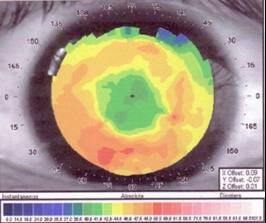
Picture F: Keratotopogram My Left Eye, Post RK 27 y.a.
To report a case of spectacle-free reading in presbyopic patient post Broad Beam laser operation.
(Superficial PRK).
A 46 year old man, who had his left eye operated on using superficial PRK 5 years ago, in 2005.
His right eye has not been operated on and he has continued to use the same power contact lens.
Use of the Profile 500 created by the Fyodrov Institute for the superficial PRK. Keratotopography TMS-ⅡN and other routine exams pre and post refractive surgery.
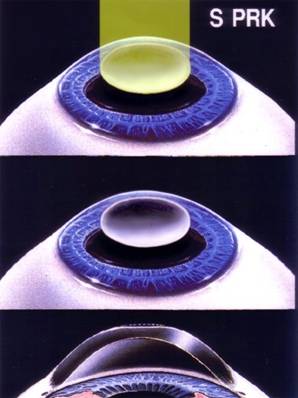
Picture A: Broad Beam laser (superficial PRK)
Pre operative data for the left eye SE -6.00D / BCVA 1.2 / UCVA 0.03 in distance.
Comparative to superficial PRK but a non scanning laser.
Plus points:
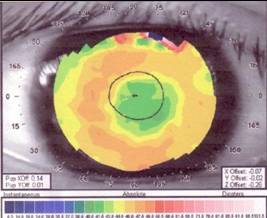
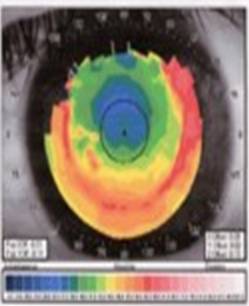
Picture B: Keratotopogram of the patient left eye
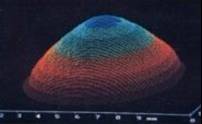
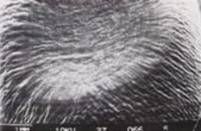
Post operated left eye using superficial PRK was successful with both near and far vision.
This finding leads me to hypothesize that I have created an aspheric refractive multifocal corneal surface similar to a multifocal refractive IOL.
1.Broad Beam Laser using one very powerful , solid multi intensity laser which creates a kind of photochemical vaporization.
2.Multifocal abrasion via smooth laser energy distribution to create a multifocal refractive surface.
3.Transepitherial superficial PRK is a One Step operation combining both the epitherial and stromal mode.
4.Flapless operation gives me the ability to use the greater (diameter and depth) refractive corneal surface to maximize the patients potential multifocal refractive surface.
In technical collaboration with the Fyodorov Eye Microsurgery Institute, Moscow,
The Sangubashi Eye Clinic, Shimouma Setagayaku,Tokyo, has developed Flapless Lasik ( corneal abrasion is made by a broad beam laser, and does not use any knife or surgical instrument ) myopic refractive surgery using only an excimer laser.
The Fyodorov Institute has conducted more than 100,000 cases of PRK treatment since 1987.
In brief, Flapless Lasik is myopic refractive surgery, by flattening the convex curve at the center of the cornea through abrasion of an optical zone of about 6.7 mm in diameter with a volume three dimensional excimer laser.
Due to using Flapless Lasik, we reached a high accuracy rate in refractive effect of more than 93% and get as close as possible to 100% using regenerative tissue control during post operative care.
It is highly safe and effective.
Depending on the degree of myopia and corneal thickness, the depth and the area of abrasion vary for different patients.
In cases of extreme myopia and very thin cornea, Flapless Lasik re-operation may be called for.
| Degree of myopia | Degree | Price |
|---|---|---|
| Mild myopia | -0.5D ~ -3.0D | 20MAN YEN+Tax【Both Eye】 |
| Middle myopia | -3.0D ~ -5.0D | 30MAN YEN+Tax【BE】 |
| High myopia | -5.1D ~ -8.0D | 40MAN YEN+Tax【BE】 |
| Severe myopia 【Level 1】 | -8.1D ~ -9.0D | 50MAN YEN+Tax【BE】 |
| Severe myopia 【Level 2】 | -9.1D ~ -10.0D | 80MAN YEN+Tax【BE】 |
| Severe myopia 【Level 3】 | -10.1D over | 100MAN YEN+Tax【BE】 |
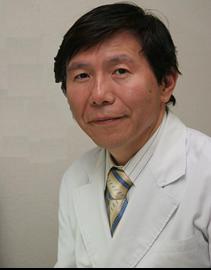
Dr.Kodo Okuyama
1974 Graduated from the Second Moscow Institute (Moscow University of Medcine).
Received a Russian Medical licence.
1975 Received a Japanese Medical licence.
1976-1983
Worked at Fujimi Hospital and Tokai University of Medicine.
1983 Received Refractive eye surgery (RK) from Prof.Fyodrov Moscow.
1983 Opened Sangubashi Eye Clinic (The first clinic in Japan which specialized in Refractive eye surgery).
1989 First farsightedness operation in Japan at our clinic.
1992 PRK (Photo Refractive Keratoplasty) at our clinic
1995 Received a PHD in Refractive Eye surgery.
1996 Received a specialist licence in Ophthalmology (Russia).
Carier highlights: Guest Prof. at Kazakh Medical University.
Ex W.H.O research center fellow.
Editor of Eye Surgery Journal.
Dr.K.Okuyama and his Clinic.
Sangubashi Eye Clinic are now using the forth generation operation Developed by Dr.K.Okuyama.
The generations are as fellows;
1. RK 1984-1991
2. PRK (Super-PRK) 1992-2004
3. Flapless Lasik(Superficial-PRK+MMC) 2005-
Generation 4 was developed by Dr.K.Okuyama and takes the operation to the next level in tissue care.
The Sangubashi Eye Clinic was founded as the first refractive eye surgery clinic in Japan in 1983.
Refractive corneal surgery corrects nearsightedness, farsightedness, astigmatism and helps presbiopia, so called refractive errors by changing of corneal curvature using RK, PRK, Lasik,
Intralasik or Flapless Lasik operations.
As a clinic specialising in refractive eye surgery.
we pay attention to the following:
1) Testing on myself, members of my family and staff. Checking to make sure it’s safe and effective.
2) Visual Acuity: using cutting edge technology to give patients the best results possible.
3) Quality of vision: to enhance everyday activities, jobs, sports etc.
In 2011 our Clinic celebrated it’s 28th anniversary, until now more than 20,000 eyes have been operated on and not one eye lost.
More than 200 Japanese eye doctors have attended our clinical conferences.
Refractive corneal operations have become more popular and accepted as a common part of modern medicine.